
A Bad Buzz
from the novel The Years of Village Smith

A Bad Buzz
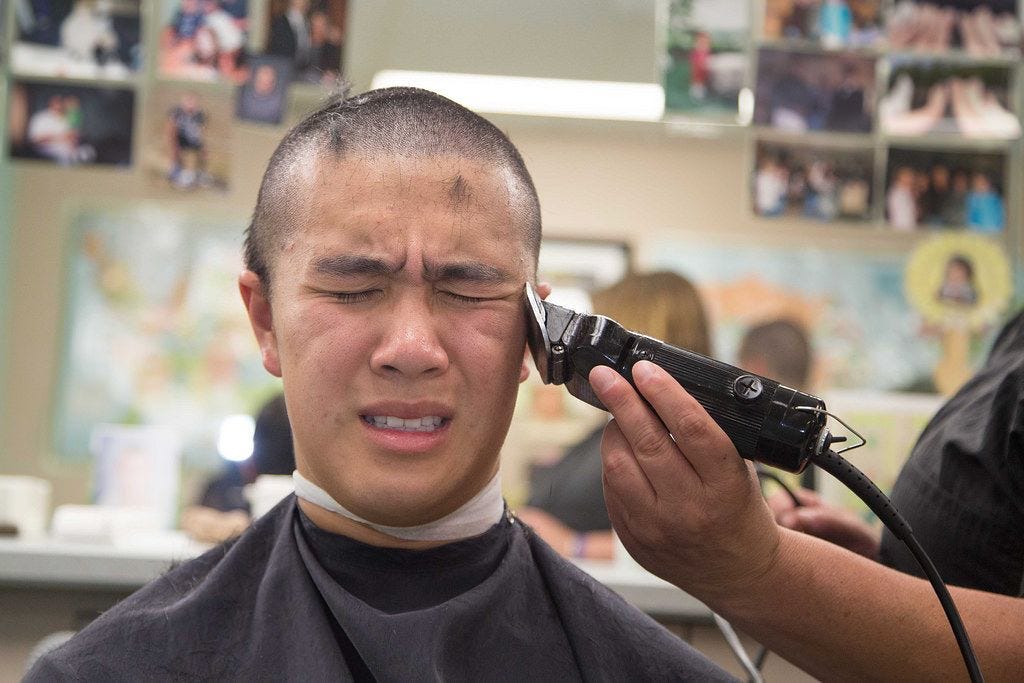
Every two weeks on a Saturday morning Vill would scoop up two dimes and a nickel from his mother’s Wedgewood change saucer on the kitchen counter and walk the fifty yards to the Disciplinary Barracks to get a haircut from a convict.
Vill, his parents, his older sister, Sharon, and Archibald the beagle lived in the oldest quarters at Fort Leavenworth, a building so steeped in history it had a name: The Rookery. Legend had it that Libby Custer had stayed there while husband George roamed the frontier chasing Indians.
Fort Leavenworth’s Disciplinary Barracks (DB) was the U. S. Army’s “big house,” twin brother to the federal penitentiary in the umbilical town of Leavenworth. To be committed to the DB, a soldier had to have been convicted by a general court martial for violating the Uniform Code of Military Justice, or at least that’s the impression Vill and his friends had. The offense could be as grave as striking a superior officer or as minor as being AWOL for more than 30 days, after which time a man was labeled a deserter.
In wartime, the Army shot deserters, Vill was pretty sure of that, but the press called Vietnam a “conflict,” not a war, so they might be stashing deserters here in Kansas while the Army courts pondered their fates. There was a lot Vill didn’t know about the inmates of the DB.
What he did know was the Army saw fit to train prisoners in a marketable trade during their incarceration. Hence, Vill’s bi-weekly trip to the prison barber shop. He also knew the inmates would receive dishonorable discharges upon their release, making him wonder how they really felt about their marketable skill when the discharge pretty much killed their chances of getting a job when they got out.
Vill kept his hair reasonably short in spite of recent trends. The 12th grade in-crowd boys, one of which Vill strived to become, bounced uncertainly from their older brothers’ style based on the Lettermen’s flattops, to the racier Elvis Presley ducktail, to the radical new Beach Boys’ surfer look. Like most Army brats, Vill was somewhere in between. With a flattop, he looked like a little boy, and at his school only the shop kids and the greasers wore ducktails. Vill liked to push his hair toward surfer length, but he hated it when it tickled his ears. He always ended up asking barbers for a “regular haircut,” knowing it would grow out quickly to a length he was comfortable with. Besides, it’s what his dad always asked for.
Like his high school buddies, Vill intended to go to West Point, which famously sheared new cadets like sheep. The buzz cut to end all buzz cuts.
If he made it to West Point. A month earlier, six of Vill’s friends had been awarded appointments to the Military Academy, and he had not. Instead, he’d received an official missive from USMA that placed him in limbo, declaring him “qualified status pending,” West Point’s term for waitlisting. He’d just gotten the letter yesterday. His chances for admission weren’t looking good, so Vill was in a dour mood as he walked through the reinforced glass doors that led to the visitors’ area and the barber shop.
Of the two vacant chairs, a white inmate stood beside one with a cape draped over his arm, and a black inmate stood beside the other. The white guy’s nametag said “James” and the black guy’s said “Washington.” Both wore the telltale buzz cut of all prisoners, and both had been stripped of rank as well as hair. Buck privates. He wondered if he would be getting a haircut from a deserter or a murderer on death row. No, he thought, a man slated to die had no need to learn a marketable skill. Vill sat down in Private James’s chair.
In short order, he was almost lulled to sleep by the soft buzzing of the clippers. Private James, who snipped away for fifteen minutes or so, woke Vill by moving fitfully from one side of the chair to the other, shaking his head in confusion and mumbling “I don’t know, I just don’t know.” Vill began to feel anxious.
Private Washington had chaired the customer who’d come in after Vill and was busy cutting that man’s hair. When he heard James groaning, Washington glanced at Vill’s head and barked at his trainee buddy, “James, man, just stop cutting.” He finished the client he was on and switched over to fix whatever James had done to Vill’s hair. Vill relaxed a little. The black man seemed more experienced. Why didn’t I start with him? he thought.
Washington finished Vill’s haircut and swiveled the chair around to give him a peek in the mirror. Vill gasped in horror.
“Sorry, man,” said the barber, “it’s all I could do to even it out.”
There were white sidewalls all the way up to where the part would have been if the hair had been long enough to part, and all that was left on the top was a barely combable tuft. As close to a buzz cut as you could get without it being a buzz cut.
Vill lost it. “What the hell!?” he blurted. As soon as he said it, however, Vill couldn’t believe he’d lost control like that. He was close to crying.
“Sorry, man,” said Private James. “You just got one of those small heads, you know?”
“James, shut up, man,” said Private Washington. He’d seen this sort of privileged rage before.
“What?” said James. “I couldn’t get the sides to come out even. That’s the truth.”
“It don’t mean nothin’,” said Washington.
“You know who my father is?” shouted Vill. It just spewed out of his mouth. “Colonel Smith. We live right over there.” He pointed to The Rookery as if it were the White House. As if DB inmates cared where colonels lived.
Private Washington moved to the other side of the barber shop to escape Vill’s puny wrath. Private James started to apologize again, but he saw Washington shake his head. Then he, too, walked away from the irate teen to join his buddy. The two men folded their arms and looked at the floor.
Vill sputtered on. He’d never used his father’s rank as a weapon before, and he wasn’t sure why he did it now. He felt embarrassed. He dug in his jeans pocket for the coins, left them on the nearest counter, and hurried out of the DB.
It was only Saturday morning, but 48 hours wasn’t nearly enough time for his hair to grow out. Monday morning, the whole school would see his scalped head. He could hear the jibes now. “Getting an early start on West Point, Vill?” “Get your head caught in a lawnmower, Vill?”
Not only would he look like a shorn dog cowering in front of the pack, but Vill didn’t have a date for the prom yet. With this scalp job, no self-respecting girl would go with him to the dance.
He moped around the Rookery for the rest of the weekend, snapping at his mother for any and no reason, especially if she said she liked the haircut, which she did a couple of times before getting the message he’d never agree.
“My friends know me with hair. Now I have none,” he exclaimed. “Friends or hair. I look like a little boy.”
“Why don’t you wear a hat then?” offered his mother.
“That’s stupid,” he said. But it hadn’t occurred to him until she suggested it, so he considered it.
By Sunday evening, he’d chosen a miniature version of his dad’s fedora, the kind that Broderick Crawford and Humphrey Bogart wore onscreen and every adult male in America had owned since World War II. Vill had a size six-and-a-half head, an embarrassingly small noggin, and none of his dad’s hats fit him, so his mom rooted around in the attic for a hat she’d bought him for a funeral a few years ago. Jesus, a few years ago! He’d been a little kid!
The hat, Vill would learn later when sartorial style meant more to him, was a mongrel cross between a fedora and a trilby, with the narrow brim of a porkpie if he turned it up, which he didn’t. Dark brown with a solid black band. Completely goofy, he thought when his mother had him look in the mirror.
“Looks pretty good to me.” Vill searched her face for any sign of sarcasm and found none. She meant it.
“Makes me look like I’m in elementary school,” he said, scowling and throwing it down on the counter beside the donuts.
“Well, it covers the haircut. Isn’t that what you want it for?”
Vill didn’t answer, but come Monday morning, he gathered up his books, made a dramatic display of yanking the hat off the kitchen counter, pulled it down to his ears, and set off for the bus stop.
To his surprise, nobody on the bus said a word about his hat or the bad haircut it camouflaged. When he got to school, his friends smiled at his approach, and their comments were all about the cool hat. His friend, Twig, even said he looked like a jazz musician.
In the hallway before first period English the nicest girl in the senior class, Susan Beddow, said, “Wow, Vill, I never saw you in a hat before. I like it. Looks kinda bohemian.”
Those who heard Susan followed her lead. The harshest comment he got was from his best friend, Tom Bardwell, who gave him shit all the time anyway, so a flippant “fucked up hat, man” seemed pretty tame compared to other insults Tom had thrown his way.
He did have to remove the hat for certain classes in which the teachers enforced the stupid rule about no hats in class, but nobody’s disapproval of his short hair matched Vill’s own melodramatic reaction to the scalping. All in all, the day of the haircut and the hat seemed to go well.
At the end of the school day, Vill boarded the bus home with his friends. Archie McGill, his other best friend, had been uncharacteristically quiet all day long about Vill’s new sartorial choice. Vill suspected Archie was trying to come up with the perfect jibe. The bus made a few stops and let some kids off, leaving only three: Vill, Archie, and Lin Holly, a cute junior who was wearing her cheerleader sweater and skirt.
“Hey, Vill,” said Archie, and Vill braced himself for something about the haircut, “who you going to the Prom with?”
In his anxiety about how his friends would react to the new buzz cut, Vill had forgotten about needing a date for the prom.
“Nobody,” he said.
Archie’s eyes twinkled with mischief, and he glanced conspiratorially at Lin, who sat a couple of seats behind Vill on the other side of the aisle. Vill followed Archie’s eyes and caught Lin looking down quickly. He felt his newly-shorn scalp get so hot he thought the fedora/trilby/porkpie was probably smoking.
“Why don’t you ask Lin?” said Archie, “I don’t think she has a date either.”
To Vill, an angular Ichabod Crane of a boy mostly unlettered in the art of girls, Lin was an unreachable goddess who had dated a hot-shot senior last year when she was only a sophomore. Although he hadn’t seen her with a boyfriend this year, Vill considered Lin way out of his league.
The girl herself glowed just two seats away listening to every word. Vill couldn’t look at her now, knowing she knew what he was going to do.
The bus came to a stop, and Vill heard Lin gather her books to get off. As she glided on winged sneakers down the aisle past his seat, Vill managed to ask her to the prom.
She smiled like Aphrodite, not answering right away, continuing to the exit door. Vill’s heart pounded somewhere behind his trachea. Lin started down the bus stairs, paused on the last step, only her luminous head and shoulders visible. She turned back to face him, and said, “I’d love to go with you, Vill. You gonna wear that hat?” Archie howled with laughter.
Vill told his mother that his friends didn’t think the scalp job was as terrible as Vill thought it was.
“That’s nice. What did you say to the barber, Vill?”
“What do you mean?”
“Well, you were pretty upset when you came home so I’m wondering if you remembered to thank him.”
Vill couldn’t believe how clairvoyant his mother was. He could lie, of course, and she’d never know it. Yes, she would.
“No, I didn’t thank him.”
“What did you say?”
“I told him I was Colonel Smith’s son.”
“Were you angry when you said it?”
“Yes, but I didn’t say my dad was going to do anything.”
“Doesn’t matter, Vill. You were rude to him, weren’t you?”
“I guess so. Yes, I guess I was.”
“Okay, you need to go over there and apologize to the man.”
“What? He’s just a prisoner, Mom. He could be a rapist. Or a murderer. He won’t care if I apologize.” Vill pictured himself walking into the DB, confronting Private James with an apology, and getting stabbed in the jugular with barber’s scissors.
“Vill.” She waited, her arms folded in resolve.
Vill waited too, but he knew he couldn’t outwait his mother. His father couldn’t outwait his mother.
“Okay. I’ll do it. Saturday, I won’t need a haircut, but I’ll go over there to apologize.”
“Village Smith, you’ll go over right now.”
He threw his books down on the dining room table, making sure he didn’t knock anything off.
“Go on.”
Vill stalked out the front door and made his way to the DB. If he was lucky, Private James wouldn’t be there and he could turn around and come home.
But Private James was there. Private Washington was cutting the hair of Colonel Hanna, a neighbor on Sumner Road and one of his dad’s golf partners. Private James was leaning his back against the wall, waiting for the next customer and reading the Stars and Stripes. When he saw Vill, he folded up the newspaper, not knowing what to expect. Private Washington looked up from cutting Col. Hanna’s hair. Both barbers stared at the teenager.
Vill took a couple of steps toward Private James, tilted his head down, and said, “I’m sorry for the way I acted on Saturday. I was worried my friends would . . . give me grief about my short hair. I shouldn’t have said what I said.”
Private Washington’s mouth fell open a little. Private James tucked the newspaper under his arm.
“It’s okay.”
Vill started to leave.
“So your friends were okay with the haircut?”
“Yeah. I wore a hat most of the day to cover it up, but they all saw my haircut. It was okay.”
Private James smiled. “Good.”
Private Washington resumed cutting Colonel Hanna’s hair, and he said to Vill without looking at him, “Thanks for coming back.”
Vill nodded and left.
Colonel Hanna said, “Kid could be going to West Point. You know his mother made him come back and apologize, right?”
“Yessir.” Private Washington knew he’d said enough already, but he thought, kid’ll be okay if he keeps listening to his mother. “My mother would have done the same thing.”