
Calvin's Back Yard
A Novel, Chapters 42-47

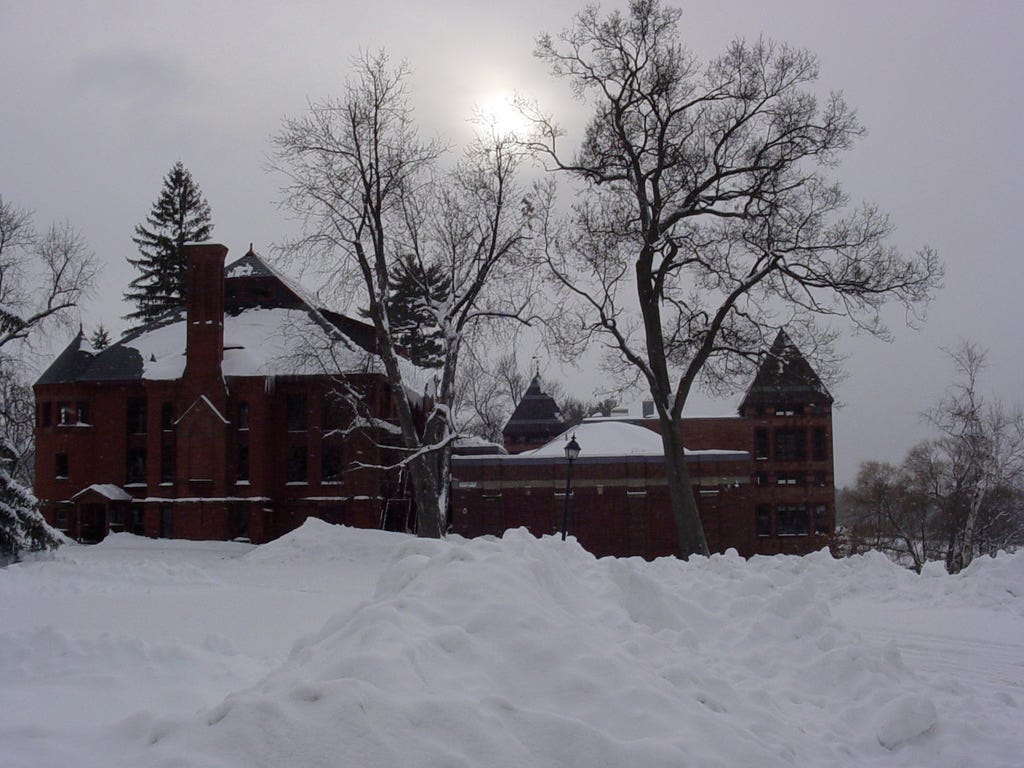
42
In the hierarchy of final events in a school year, the freshmen learning which dorm they’ll live in for the next three years seems rather pedestrian, but to the freshmen it’s pretty damned exciting. They spend an afternoon being wooed by faculty from the various dorms, like college freshmen being rushed by a fraternity or sorority. At the end of the afternoon, they turn in a list of their preferences, and then the Residential Dean tells them later that evening where they’re going to live. The whole process is streamlined to be accomplished in one afternoon, but it ends up consuming the time of dorm faculty all day as they vie for certain kids and try to avoid others.
Dorms, after all, have a need to perpetuate their reputations. If Johnson Hall is known for strong academics, the top academic freshmen might want to go to Johnson Hall, which had maintained the best GPA for the last five years. If a freshman girl played field hockey, she might want to go to First Hall, where for years many hockey players had lived.
Of course, there were dorms that wanted to ditch their reputations. Throckmorton West was notorious for the butt room kids blowing dope, and somehow the dorm annually received newly-minted sophomores who either had already tried marijuana or would dabble in it pretty quickly the next September. Thus, on Dorm Day, the faculty of Throckmorton West campaigned like rabid Republicans for some of the brainiacs in the outgoing freshman class and hoped the potheads would go to Johnson Hall.
The rude-truth subtext was that every dorm had its potheads and its academics, and that the two were not mutually exclusive anyway. The rude-truth sub-subtext was that, though the freshmen anguished over it as if their whole life path depended on which dorm chose them, the dorm staffs were so exhausted by the end of the process they didn’t give a damn where the last few kids lived.
Because of Dorm Day, Vill had to delay passing on to Tow what he’d learned from Jen Poole until dinner while he escorted the various waves of freshman boys on their tours of Chen Hall. At dinner, he sat down with Tow, dreading the conversation. He breathed more easily when Tow began his report on his time interviewing Norma Lee.
“You got a good one there, friend,” said Tow, taking a bite of his baked chicken and thawed frozen vegetables, which the depleted dining hall seemed to serve a lot in May.
“I don’t know why, but I think Norma Lee loves you,” he joked. “Anyway, she says Pinehurst almost propositioned her with a variation on the champagne technique. He baited her by asking her to bring some pictures of her Peace Corps time, and he offered to show her, over a glass of wine, some pictures of his visit to Santo Domingo. Creeped her out, so she begged off. He never tried again.”
Vill nodded, with a foolish smile on his face.
“How about Jen?” Tow tried to act unconcerned, but his eyes bounced quickly between his food and Vill’s face.
“Just like Norma Lee,” said Vill. “Almost exactly. He offered, she recognized it, she politely declined. Over.” Vill had rehearsed the lie, and it surprised him how smoothly it came out.
“Fantastic!” said Tow.
“But she thought it was cowardly of us to switch girlfriends for the interrogation, so you have some explaining to do.”
“Oh, well, that’s better than the alternative.”
“Which is?”
“Which is that she could have fallen for Pinehurst’s line and gotten pissed for having to tell you instead of me.”
“Right,” said Vill. He felt his face flushing, probably as red as the Security barns.
Tow dug into his food with gusto. “Ok, who’s left? I tell you, Wei-Xin Huang’s shot up my list. She’s ambitious enough to kill for Pinehurst’s job. I still haven’t crossed Karen Richards off, or Lee Richards, or Soo Bum Chang, or Judy Seaman. Jesus, we haven’t eliminated anybody except our girlfriends,” said Tow.
Vill offered, “Why don’t you let me talk to Wei-Xin. You should probably check in with Chief Tessier on Roach’s murder, don’t you think? I can’t help you with that until you need some of my military contacts. And even then . . .”
Tow paused with a huge bite of chicken marsala on his fork. He looked askance at Vill. “Yeah, sure.” Why did Vill want to split their efforts? Why did he want Tow to shift his focus away from the Pinehurst murder? His suggestion made no sense. It was the first time in Tow’s knowing him that Vill acted hinky.
Tow put down the bite of chicken and said, “I’m going to go pick up Jen for dinner.”
43
Prep school jobs are often drudgery because living with other people’s children 24/7 saps the energy of the adults who oversee their lives. There’s not a lot of time for refreshing yourself. When they gathered sporadically at social events, faculty tended to commiserate about boring dorm duty that lasted till almost midnight, about chaperoning weekend events too frequently, and about feeling like semi-well-paid babysitters instead of poorly-paid professors.
Rarely could anyone admit that the life grew on you. Vill and his teaching cohorts were sustained by those endearing moments when an adolescent who was preoccupied with his own study schedule or her own athletic team or their own intense social drama would look him square in the eye and thank him for the college recommendation that helped get him into Elms College or Yale University. Or tell him he was the best English teacher she ever had, something he let himself believe for the rest of the day because it felt so good to hear it.
Having lied to Tow about his interview with Jen, Vill wasn’t feeling too good about himself, so when Becky Dinsmore, one of the “criminals” from the AP Lit class that had turned up the clock, approached him at his dinner table with Dan Forrest trailing her like a puppy dog, he was a little surprised when she proffered a cardboard cylinder containing one of those posters that proclaimed the latest bumper-sticker wisdom.
“Mr. Smith, the class got together and wanted to give you something for the way . . . well, for what happened,” said Becky.
“Uh, okay, Becky,” said Vill, accepting the gift. “You want me to open it here or tonight when I’m alone?” His meat loaf cooled as he spoke, a coating of milky gravy beginning to congeal.
“You can open it here,” said Dan.
Vill broke the scotch tape seal and inched the fitted top off the cylinder. Inside was a roll of glossy paper.
“Oh,” he said, unrolling it. The picture was a stock photograph of mountains, maybe the Rockies or Sierras, it didn’t say. But in the top border of the photo the word “INTEGRITY” spread prominently across the page, and on the bottom border in smaller letters was a supporting aphorism, “Say What You Mean, Mean What You Say.”
Vill choked on his spit, and his eyes welled up. When he was finally able to look at them, he was distracted by Jen Poole’s entering the dining hall with Tow by her side. Tow was smiling. Jen didn’t look Vill’s way.
“We just wanted to do something. As a class.” Vill heard the voice but had momentarily forgotten who was speaking. It was Becky.
“Thanks, Becky. Thanks, Dan. I’ll thank everybody else when I see them, but if you see them first you can say I appreciate the poster. And what it represents, that’s not lost on me either. Thanks.”
Mercifully, they left Vill to himself. He returned the poster to its cylinder.
“I got a bone to pick with you, man,” said Tow, who materialized suddenly.
“Really?” said Vill. “I’m sure I can explain.”
“You better,” said Tow. “You didn’t tell me everything Jen said.”
Vill was confused. Tow didn’t seem upset, but he should be if Jen told him the truth.
“What did I leave out?” asked Vill.
“The part about her going to see Jack when Agatha told Jen about the rape.”
“Oh, did I leave that out?” Vill’s mouth dried up.
“Yeah, you did,” said Tow. “Jen didn’t tell us that, but Chief Tessier never asked her about it, so she’s in the clear for withholding evidence from the police. But it would have been nice to know that Jack had denied a rape accusation.”
“Yeah,” said Vill. What the hell had Jen said to him?
“So Jen knew that either Jack was lying or Agatha was lying, but she didn’t know it was Agatha until Roach bought the farm and I told her.”
“Yep,” said Vill. “Sorry I didn’t tell you everything she said.”
“Yeah, me too, friend. But here’s the thing, she didn’t say any of that,” said Tow, staring him down now. “You lied to me. You want to tell me what my girlfriend did say?”
As Vill paused, Tow got angrier. “Hasn’t she told you anything yet?” said Vill.
“No, I just picked her up two minutes ago. Haven’t had a chance to ask her. Spill.”
“I can’t be the one to tell you, man. Jen has to tell you herself.”
Tow turned to peer over his shoulder at his girlfriend, who’d been staring urgently at the two men. Their eyes met briefly, and Jen turned her head.
“Holy shit,” he said, “she killed him, didn’t she? She told you she killed him.”
“Tow, listen.” Now that his friend had figured out the truth, Vill couldn’t confess fast enough. “I met Jen briefly at West Point. Years ago when I was a cadet. My roommate raped her at a dance, and he got off clean because he lied. But I didn’t recognize her as that girl until today. And when Agatha told Jen that Pinehurst raped her and then he propositioned Jen, she accepted his offer so she could kill him for raping Agatha. Now that we know he didn’t really rape Agatha, Jen’s an unwitting murderer, right? So her crime is clearly mitigated. I didn’t want to tell you because . . . well, because . . . “
“Because there’s a greater good here?” Tow asked, scrunching up his face.
“Yes,” pleaded Vill, “there’s justice here, Tow. Jack ruined so many lives, and Jen’s life . . . she has every right to revenge, doesn’t she? It’s kind of perfect that she’s taken revenge on a rapist. Not her rapist, of course, but a scumbag, right?”
“Are you hearing yourself, Vill? I can’t believe you’d let her get away with killing the Head of the School. It’s murder, Vill, just like Roach murdered that double agent. Doesn’t matter how reprehensible one human being is, man, you don’t get to bypass the whole justice system to wreak revenge. Is this what they taught you at West Point? That you don’t lie unless there’s a greater good? And you always get to decide when that is?”
Jen had been watching their conversation, and when she started to leave the dining hall Tow followed her, catching up at the door to her apartment. When he placed his hands gently on her shoulders, they looked like a loving couple on the threshold of a tryst.
“Vill had decided not to say anything, didn’t he?” she said, not turning to face him. “But you, my sweet beau, you figured it out anyway.” Jen reached back and tenderly covered his hand with hers. “He wants to do the right thing, Tow, but he doesn’t know what that is anymore.”
Tow wanted to have this conversation with her, but his sense of duty prevented it.
“Jen, you have to come with me. I’m taking you to Chief Tessier. I think there’s not a jury in this country that’ll convict you. At least not of first degree murder. Maybe of manslaughter or something like that. But you have to face the law.”
“I know, Tow. I know. Let me get my things.”
“I can’t leave you alone now,” he said.
“Of course.”
44
Unable to settle herself in the Delahanty’s living room after another sleepless night, Connie Roach decided to go for a morning run. Her body’s fitness seemed like something she could attend to without having to think much. Of course, during the run her husband’s death plagued her thoughts anyway. His body lying on the floor in its own blood, a little of hers mixed in to confuse the authorities. As a spouse, she would be suspected anyway, so why not give them a little misdirection.
She’d run down Home Road so many times that the familiarity of the houses she passed brought her comfort. An elderly couple waved to her from their well-groomed yard, pretending that more yard work needed to be done, she thought, when they were probably just bored in their retirement. She waved back perfunctorily because that’s what she always did. Low-key courtesy drew no attention.
For her entire adult life, Connie had performed exactly what had been expected of her. As a young lieutenant’s wife she had laughed at the colonels’ bad jokes, dodged their half-hidden flirtations, and waited for Michael to return from the Korean War. As a colonel’s wife she’d laughed at the generals’ bad jokes, fended off their half-hidden gropings, and waited for Michael to return from Vietnam.
Always, she kept in good shape, waiting for her turn. After Vietnam, when Michael was transferred to Korea, her turn finally came.
It was exhilarating. Better than sex.
In Seoul, helping him stage the jeep accident popped her professional cherry. That’s what Mike had called it. In Paris too. Turns out she was a natural for this work. She was able to prepare thoroughly and execute a plan. If something unexpected came up—like the grandchild of one of their Korean victims exposing Michael—she did what was necessary. Cut her losses. She was conflicted at first, but her duty was clear. Michael had become a liability.
After a mile, Connie turned left on Louisiana Road, left again at the dirt service road for the Louisiana Road Fields where Michael’s lacrosse team had practiced, and jogged slowly into the cover of the woods behind the little league diamond. As she pulled up for a breather, a figure came out from behind a tree, a man with uneven ears and a cock-eyed smile.
“’Lo, Mrs. Roach,” said the man.
“Hello, Sid,” said Connie.
45
“I’m surprised you’re talking to me at all.” Vill was whipping a couple of eggs in a bowl when Tow knocked on his door. “You want an omelet?”
“Whatcha putting in it?” asked Tow. He acted like a visiting chef out to embarrass the cook in his own home.
“Onions, red peppers, and cheese.”
“What kinda cheese?”
“Jesus, Tow, is this an official visit, or are you looking for Julia Child?”
“Official,” said Tow, switching into full interrogation mode. “What did Jen say to you? Her exact words.”
Vill went from friend to suspect in one second. It surprised him that the cop standing before him had ever been a friend.
Sheepishly, Vill complied. “Well, she said she came up behind him and beat him senseless. Is that what you mean?”
“Yes, her exact words. Start at the beginning.” Tow’s every word was harsh, a challenge to Vill not to fuck up, not to lie.
“Okay. She said Jack invited her to his house, didn’t say exactly when but sometime during the day of Senior Streak. She told him she would come to his house after Senior Streak was over and she’d checked her girls into the dorm. She went over to Johnson House, accepted a glass of wine from him but didn’t drink it. I assume that was because she knew he might have drugged Agatha-- . . .”
“Stop,” said Tow, “No assumptions or conclusions. Her exact words and that’s all.”
“Sorry. Okay, glass of wine, listened to him play the piano, struck him in the head until he passed out on the piano bench. With her fists, she said. Beat him senseless. That’s what I remember her saying.”
Tow pondered Vill’s “testimony.”
“Okay. She just told Tessier and me in her statement that she left him slumped over the piano keys after he passed out. When Bobby asked her about blood, she said there was a little where she’d hit him, and she didn’t remember any other blood.”
Vill said, “Whoa, wasn’t there a ton of blood on the piano and floor?”
“That’s right.”
“There’s a chance Jen’s attack didn’t kill him?” Vill was wide-eyed now.
“A chance, yes,” said Tow. “That’s why you should have told me the truth, numbnuts.”
That’s encouraging, thought Vill. “Numbnuts.” A filial term of endearment. “Yeah. Sorry again,” said Vill cautiously.
Vill’s mood brightened as Tow lapsed into the old familiarity of bouncing his thoughts off his friend. He hoped Tow was as tired of the cop act as Vill was.
“Jen’s a strong girl, and I’m pretty sure she could kill a man with her fists. Her confession makes her the prime suspect. But to kill him she’d have to hit him so many times that the blows would cause severe bleeding, internal or external. Or he would have to bump his head on another surface so hard that it would kill him. The ME says he bled out from multiple head wounds, and that’s the cause of death. It sounds like Jen hit him maybe four or five times, enough to render him unconscious, but if her blows didn’t open the wounds that led to his bleeding out, then it’s possible he was alive when she left and somebody else picked up where Jen left off. And she left the scene thinking she probably killed him.”
“As if.”
“What?” asked Tow.
“It ‘sounds as if she hit him,’” said Vill, smiling. “All’s forgiven?”
“Not on your life,” growled Tow. But he was smiling.
46
“It was the night before graduation, and all through the school, seniors stayed up past twelve, thinking it was cool.” Chen Hall seniors groaned at Vill’s doggerel. They lounged out on the steps of Chen with dorm faculty simply because they could, reminiscing about their time together, that year and maybe the last four years. They hoped graduation and the end of school would come quickly, but they didn’t want their last night of high school to end either.
About 1:00 a.m., when faculty begged off to get some sleep, the seniors wandered to other dorms because, with eleven hours left as high school seniors, dorm closing had been suspended and nobody cared if they violated minor rules anyway. As long as they didn’t go overboard and get roaring drunk or something dumb like that. And even then, faculty might not leave their apartments to collar a drunk senior. Vill thought it was a lot like a basketball referee pocketing his whistle in the final minute of a close game so that he didn’t inadvertently call a foul that decided the game.
Taking advantage of the faculty tolerance on this final school night, Agatha Lee sat with Soo Bum Chang and Jae Hyun Park in Soo Bum’s room in Chen Hall. Mike Roach was dead, so they’d abandoned the plan that had caused them so much anxiety all year long, but his death had shone a new light of police attention on them. Head of Security Tow Linscott had brought them to his office that afternoon and questioned them relentlessly. None had buckled. They made sure that they, or other Korean students, had vouched for their whereabouts when Roach was killed. The alibis were pretty shaky, however, because the boys and girls who’d supposedly seen them after dorm closing had to have been awake and in the wrong rooms when they’d sworn earlier that they’d been asleep in their own rooms. Linscott didn’t believe their new stories. Nobody would have.
“It’s a problem our alibis don’t hold up,” said Soo Bum.
Agatha disagreed. “It doesn’t matter. They can’t prove we were at Calvin House if we weren’t there.”
“But they will continue to look at us for Roach’s murder,” said Jae Hyun.
“We will be gone soon,” said Agatha. “There’s no way they will find anything on us before we leave.”
“Probably,” said Jae Hyun, but he wasn’t sure about it.
Agatha went back to Pamp House. Jae Hyun bowed to Soo Bum and climbed the stairs to his third-floor room. He had an uneasy feeling that suspicious eyes watched him as he made his way up the stairwell and down the hallway to his room.
Graduation came and went, as pompous and raucous and tearful as it needed to be. To Vill and Tow, underneath the external pomp and emotion hid the spectre of their unsolved cases. So when Agatha Lee, the valedictorian, revealed the topic of her class oration was the self-deceit of the United States as a superpower, the informed detectives shrank more than the ignorant audience, whom Agatha went on to chastise in a more diplomatic way.
“Wasn’t she brilliant?” said one mother, totally oblivious to the speech’s purpose but vaguely aware of Agatha’s eloquence.
“Oh yes,” said her husband, who also hadn’t listened to the substance of the speech.
Afterwards, families moved back to the dorm rooms to squeeze into one Chevy Suburban the stuff that same monster had taken five trips in the last nine months to bring. Parents, brothers and sisters, and new dorm RA’s bustled in and out of dorms carrying trashcans, desk lamps, coat hangers, clothes, books, bed linens, shower baskets with soap and shampoo, toothbrushes, more clothes, and dogs and cats, which had come with the cars today but which seemed to have been hidden all year in the dormitories. Music blared from student rooms until it was time to pack up the stereo systems, and then dorm staffs, overjoyed that students were leaving, blared their music. One excited dorm adviser played on a continual cassette loop his favorite line from the Eagles’ song “Hotel California” over and over: “You can check out any time you like, but you can never leave,” standing in his doorway, laughing and laughing.
Jae Hyun Park’s roommate, Jack Belisle, had finished with his own packing and offered to help Jae. Jack identified a packing box into which Jae was pitching almost everything from his desk, so Jack opened a desk drawer and started to do the same.
“Whoa, look at this! Neat, Jae! Where’d you get this?” exclaimed Belisle.
Vill was on the third floor inspecting the rooms of students who were ready for final checkout when he heard Belisle’s excitement and peeked into Jae’s room. Jack held aloft a stiletto about eight inches long, chrome blade, and plastic fake-wooden handle.
Jack read the inscription on the blade: “In meritorious service to the Joint Chiefs of Staff, Major Michael Roach.”
Later, Vill, Tow, and Chief Bobby Tessier examined the dagger-shaped letter opener. They were downstairs in Chen Hall lounge, standing in front of the fireplace.
Vill said, “Pretty lucky, Tow. Another thirty seconds, and Jae would have packed up that dagger, and we’d never have known anything.”
Tow seemed skeptical. “I know, but are we supposed to think Jae is a stupid kid keeping a souvenir from a murder he just committed? In other words, an 18-year-old kid who presumably has not killed anybody before creeps into Roach’s house at 2 a.m., cold-bloodedly kills a trained Green Beret with nothing but his hands and feet, calmly grabs the dagger as a keepsake, and absconds, placing the dagger not in a safe hiding place but in a desk drawer with his pens and pencils. Then, he doesn’t take the care to conceal the dagger enough to prevent his roommate from finding it. Come on, it’s just too convenient.”
Vill said, “You think the dagger was planted?”
Tow said, “I think it’s a strong possibility. Chief, what do you think?”
Tessier had been barely listening to the conversation. “I don’t think anything. I know,” he said coolly.
Tow rolled his eyes at the grandstanding. “What do you know, Chief?”
“I know this here dagger was planted in the kid’s desk because I saw it at Roach’s house. And I don’t have to rely on my memory. Which is good, mind you. After Roach’s dee-mise, we photographed every square inch of his house. I know I can find that ersatz dagger in a crime scene photo.”
Ersatz dagger? Holy shit, thought Vill. Who is this guy and what else have I misjudged about him?
“Okay,” said Vill, “can we ask the obvious question? Who would want to frame Jae Hyun Park?”
Bobby Tessier spoke before Tow could. “Roach’s killer. Somebody with access to the house. Connie Roach, for one.”
“Yeah,” said Tow, “but we have no motive for the wife. But Soo Bum Chang, or Agatha, for that matter, have motive to frame Jae Hyun if they did Roach. It wouldn’t take much to break into Roach’s house and take the dagger. The best time to steal it and plant it in Park’s stuff would have been when everybody was attending graduation, which would eliminate the Korean kids and puts the focus back on Connie Roach. I don’t remember her being at graduation, but that doesn’t mean she wasn’t there. We need to ask her.”
He said, “Chief, I’ll take Connie Roach, if that’s okay with you. You mind putting the fear of god into the Korean kids again?”
Tessier smiled. “I’d love to. But listen here, Linscott, I don’t want this lame-ass English teacher interrogating any more suspects. Smith, go talk to your girlfriend about . . . I don’t know, English crap. You did plenty of that before murder came to Edwards Academy, so go back to it, will you?”
Vill said, “Just for you, Chief.” He left before being asked again.
Tessier had more to get squared away with Tow. “Linscott, remind me what you found on the Korean background. What went on in these kids’ past?”
“I have to do more digging, Chief, but as of right now we know that Agatha’s grandfather and an American two-star general were both killed on the same day in 1972. The grandfather was on a secret mission for the President of Korea, and the murder made sense for politicians who opposed Park Chung-hee’s attempts at peace negotiations. The general was an embarrassment to the United States because he played around with young Korean floozies. He died in a jeep accident, along with his passenger, one of his concubines. The Roaches were in Korea at the time, and we think Roach may have killed one or both of these people for the CIA or for President Park.”
Tessier said, “So it sounds like you have to confirm Roach’s part in the deaths, right?”
Tow said, “Well, it would be nice if we found confirmation, but the Korean students drew our attention to Roach, so they already had information that he was the bad guy. Don’t ask me how they knew that though.”
“Okay,” said Tessier. “What else before I leave?”
“The Korean murder victim was Agatha Lee’s grandfather, so she has a revenge motive to kill Roach or have him killed. I still need to check into the background of Soo Bum Chang and Jae Hyun Park. Chances are they have family connections to some of this stuff. Or they could have been told to do Agatha’s bidding.”
“Okay, Linscott,” said Tessier. “I’ll come at the little buggers, see if they give me anything.”
“Right,” said Tow, “I’m off to see the grieving widow.”
47
Chief Bobby Tessier may have been a lot of things he didn’t admit to, but stupid he wasn’t. He liked playing dumb when it suited his purposes, and he resorted to dumb because he couldn’t play smart as easily. He had the mind for smart but not always the language.
When it came to interrogation, the dumb role allowed him to hide what he knew. So when Agatha Lee, Soo Bum Chang, and Jae Hyun Park trooped down to Denning Hall and the Chief’s temporary headquarters in the Head’s office, Bobby was ready for his act. He took Agatha first.
“Thank you for comin’ in, Mizz Lee.”
“Miss, please, Chief,” said Agatha, going for the upper hand right away.
“Oh, excuse me,” said Tessier, “I have taken to using what most American women are preferring nowadays. You prefer something different in Korea, do you?”
“It would take an hour lesson into the conventions of polite Korean language, Chief, and we are already rushing to make our flights home. So, if you don’t mind, I will forgo the lesson,” she said.
“Right, I probably wouldn’t get it anyway,” said Tessier. “I understand you and your friends faked a rape, two rapes in fact, so that investigators would be guided to Mr. Roach’s murder of your countryman. Is that right?”
Agatha was surprised at how succinctly Tessier had laid out the situation. “Yes, that’s right, Chief,” she said.
“You realize that taking police time and resources to investigate a faked crime is a misdemeanor itself, don’t you?”
“Yes, Chief. We are ready to face the consequences for that. But Mr. Linscott said there would probably not be anything more than a reprimand.”
“Well,” Tessier said deliberately, “that’s right, or it was until this latest discovery of Roach’s letter opener in Mr. Park’s room. Because you are still suspects for the murder of Mr. Roach, this raises the ante on the previous activities as well.”
“Oh, I didn’t know that,” said Agatha. As composed as she was, she thought about the delay for her and the boys. It could take weeks for the authorities to solve the murder of Mike Roach, possibly lasting into the fall term and jeopardizing the start of their first year in college.
“Tell me what you know about Mr. Roach’s murder, Miss Lee,” said Chief Tessier.
“I don’t know anything, Chief. I have talked with Chang Soo Bum and Park Jae Hyun, and we are certain the dagger was planted in Park Jae Hyun’s desk.”
“We have considered that as well, young lady. Any idea who would do such a thing?”
“No, Chief, I don’t.”
“Okay, I b’lieve you. Let me ask about Korea. I understand you think Mr. Roach killed your grandfather back in 1972. Is that right?”
“Yes, Chief.” Agatha was beginning to sound impatient, which, as far as Tessier was concerned, meant he was wearing her down.
“How do you know that?”
“My grandfather worked for President Park Chung-hee, and after he was killed, we learned that Mr. Roach had killed him.”
“Yes, you’ve said that already. I’m asking how did you learn it? Presumably, Mr. Roach was working for somebody who gave that information to a Korean source, who apparently gave it to you.” Chief Tessier had abandoned the dumb act. His eyes bored into her now.
If Agatha didn’t let this policeman know the truth, they might be tied up in his investigation for months.
“Chief Tessier, if you talk to Park Jae Hyun, you will find that he is President Park Chung-hee’s nephew. The President himself told Park Jae Hyun’s father, the President’s brother, that Mr. Roach was hired by the Korean CIA on loan from the American CIA to kill my grandfather.”
“But didn’t President Park appoint your grandfather as the emissary for peace talks with the North Koreans?”
“Yes, Chief, but political winds change direction in our country for unseen reasons. I can’t tell you why, but the President or the Director of the Korean CIA saw fit to end my grandfather’s mission abruptly and finally.” A single tear formed and escaped Agatha’s eye.
“I am sorry, Miss Lee,” said Tessier. He meant it. “I have to ask you about another crime. Did Mr. Park’s father say something about the death of the American general?”
“Mr. Tessier,” said Agatha, regaining her remarkable composure, “I must rely on your discretion here.”
“You have it, Miss Lee. If it isn’t relevant to our investigation into this murder, I won’t divulge it.”
“Chief, the American general was not the target of that jeep ‘accident.’ He was the diversion. The girl who died with the general was no nameless prostitute as the news reports led everyone to believe. She was my older sister, Lee Min-joo. She was killed to ensure my parents’ silence about my grandfather’s ties to President Park and that peace mission.”
“I’m so sorry, Miss Lee. You lost two family members at the hands of ruthless politicians.”
Agatha thought this man had more going for him than most of the Americans she’d met. He reminded her a little of her own father. “Thank you for your understanding, Chief. I hope I don’t need to tell you that one of those ruthless men is still President of my country and that I am a Lee.” Agatha decided not to tell Tessier about being attacked by Roach in the winter of her junior year. She couldn’t prove it, but it looked to her as if Mike Roach took a job at Jonathan Edwards Academy specifically to monitor Agatha’s behavior for the South Korean government. If she had fomented anti-government sentiment among the Korean students at Edwards or even in the news media, Roach could have snuffed it. Or her.
“Again, Miss Lee, you have my word that nothing you say to me will get out. But I have a question, if you don’t mind. If your grandfather and your sister were killed the same day, are you sure Mr. Roach is guilty of both murders?”
“Chief,” said Agatha, composed but weary now, “for your purposes, I suppose it is possible Mr. Roach had an accomplice. But from my standpoint, it does not matter. Park Jae Hyun says that the President implicated Mr. Roach and only Mr. Roach.” She stood up.
Agatha Lee didn’t say the Chief’s interrogation was over, but Tessier knew she had ended it.
The boys said nothing more enlightening in their turns with Tessier, so the Chief let them all go. He also told them they must stay in town until cleared to leave, but he didn’t think it would take too long now.