
Finding Geronimo
from the novel The Years of Smith

[Attentive readers might notice that the name of the novel has changed. It used to be The Years of Village Smith and now it’s The Years of Smith. As with all my editing changes, this is a trial title, temporary while I make the other changes it requires in some of the stories themselves. I’ll keep you posted.]
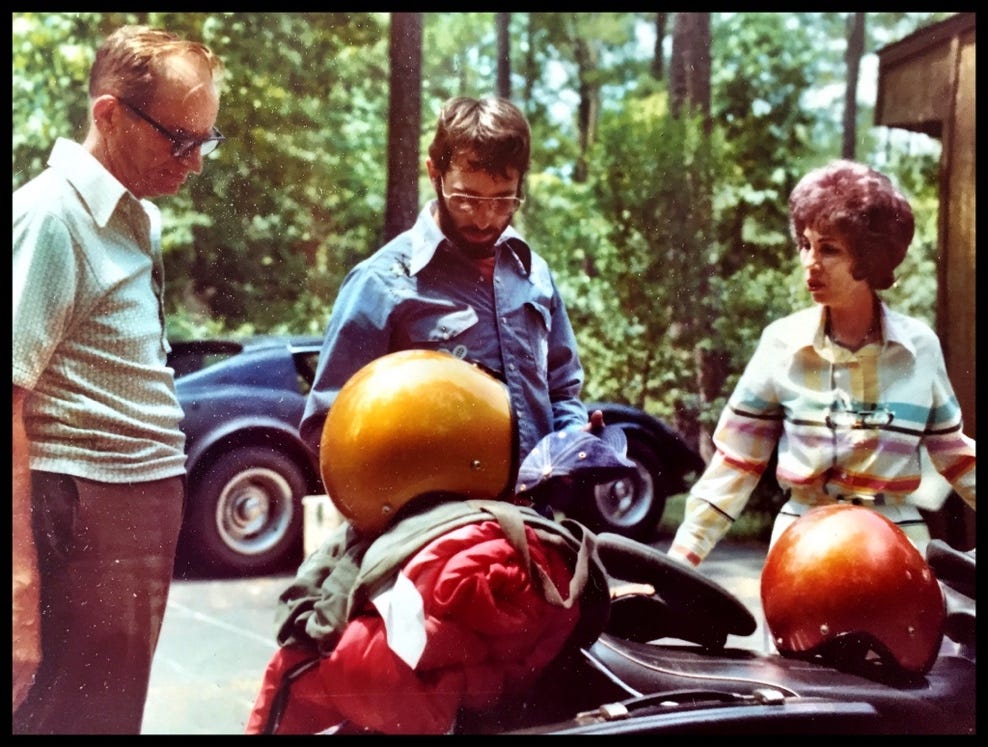
I’d just learned how to ride a motorcycle. A captain who lived down the hall from me in the Fort Sill BOQ owned three bikes—a Yamaha 150 dirt bike, and two BMW R75/5 touring machines. No, that’s not right, one of the BMW’s was an R100S. Cool racing faring with vanilla cream blended into sherbert orange.
He called those “bikes” too, but I respectfully called the beemers “machines” because those suckers weighed 475 pounds each without the faring and loaded saddle bags, and they cruised along at 100 mph with no more than a purr. I say “100 mph” blithely as though I went that fast, but the truth is I hated carrying speed on a motorcycle, or down a ski slope or peddling a Raleigh ten-speed or cruising in a 1970 GTO, my first car.
My Army buddy let me hop on his dirt bike for a couple of weeks to learn the ins and outs of the gears, the clutch, and the accelerator. Later, after we’d taken a weekend trek on the BMW’s, I bought the R75 from him.
One practice ride, I was out tooling around on the reservation with the dirt bike. This was Fort Sill, Oklahoma, the home of the field artillery and its vast firing ranges. I made sure I didn’t stray beyond the signs that read “Firing Range: No Trespassing Beyond This Point” because I’d adjusted fire myself and knew there were more duds on that range than prairie dogs. I think all the reliable artillery ammunition went to Vietnam and the suspicious rounds were sent to stateside training posts.
I was gunning the Yamaha up to 80 mph on the dusty backroads of the reservation. There’s only scruffy vegetation out there the same color as the dust and no shade in a hundred miles. It was September and still hot, and it was dry as a desiccated peach, so I pulled over every ten or fifteen minutes to drink from the canteen I’d thought to bring with me.
Bracing the bike between my legs like an old cavalryman on a mule, I swigged from the aluminum canteen and happened to glance over at a chain link fence that paralleled the trail road and was festooned with firing range signs partially obscured by whatever hardy weeds could survive without moisture in the barren landscape, and I saw two gravestones baking in the sun, seeming to guard the fenceline. They were exactly like the tombstones I saw every day on my way to breakfast in the Fort Sill National Cemetery outside the Officer’s Club. I wondered why in the hell two regulation gravestones—presumably marking the final resting places of two souls—why these graves were out in the middle of nowhere in Oklahoma.
I drove the Yamaha over to the gravestones so I could read them. I didn’t recognize the name on the stone to the left, but it seemed like an Indian name, “Zi-Yeh” or something like that (I am embarrassed now at my youthful inattentiveness and apologize to Zi-Yeh’s relatives). Below the large lettering of her name, in smaller lettering, I read “Wife of Geronimo.” Mouth opening in surprise, I swung my gaze to the other stone.
Sure enough, “Geronimo.”
I carried no camera with me, so I couldn’t document the moment in case I had to prove it to buddies in a drunken conversation at the officer’s club bar, but I pondered the scene, which begged a hundred questions not the least of which was, What in the hell is Geronimo’s grave doing in the middle of nowhere in Fort Sill, Oklahoma, in 1976?
The air down the fenceline quivered in the distance with the heat, but here at the grave site I felt a calm, cooling presence. I knew that this was not, as I had assumed, the middle of nowhere in Oklahoma, or at least that its current cartographical identity meant little compared to its ancient significance. I’m going to have a hard time describing what was happening, first because I’m white and ostensibly Christian but more because this whole scene seemed to spring from a spiritual realm whose secrets I was not privy to despite my ability to feel them in the moment.
This was clearly not the land of my ancestors, but it was the land of Geronimo’s ancestors, writ large. I sensed that this site—this land—was a mystical place, that Geronimo’s people had been here for over 10,000 years and my people only about two or three hundred. Though my perception was vague, I had no doubt that I was meant to be here. I instinctually understood that Zi-Yeh and Geronimo’s graves were some sort of conduit to a spiritual understanding of the very land I was standing on. I felt privileged to be here, “here” meaning next to this forgotten stretch of fenceline but also meaning alive, in this world at this moment. On the brink of epiphany, I shied from what I might discover, shivered in the Oklahoma heat, scurried back to the borrowed motorcycle, and left.
Back at the BOQ, I decided I should do some research, but my assignment to Field Artillery schooling delayed my good intentions, and, being the immature dolt I was at twenty-seven, I did not go to the post library to find out the answer for another month. Eventually I managed to locate a book about Geronimo that informed me the notorious Apache warrior, after eluding pursuers for decades, had been captured by the Army in 1886 and was held prisoner by the federal government for the last twenty-three years of his life. Rather than incarcerating the great man on one reservation or in one prison, the Army ferried him around to a number of military posts, showing off the famous captive when it fancied them, keeping him hidden when it didn’t, and eventually confining the old man to Ft. Sill, where he died of pneumonia in 1909.
I made a point of perusing the Indian gravestones in the Fort Sill National Cemetery, and I noticed that most of them were engraved with some cryptic version of “Kiowa Scout” or “Crow Scout,” so I deduced that these guys had fought for the United States (not against it like Geronimo), thereby qualifying them for federal burial, just like all the U.S. soldiers who died on Omaha Beach and at Pearl Harbor.
The aura emanating from the Officer’s Club cemetery was altogether different than what I had experienced out on the reservation. Here, the graves were shaded from the sun by mature bushy trees not native to this area, red oaks and sugar maples. The grass between grave markers was mown carefully and irrigated like a golf course. Walking among the stones of the various Army scouts—who, to allow themselves to be interred here, must have thought burial in a United States national cemetery an honorific—I felt an eeriness that was not spiritual at all. Everything seemed wrong here. The Indian graves, the trees, the grass, the Officer’s Club. It seemed a surreal stick painting, one from the mind of a child. A non-native child.
Geronimo, as the last major native combatant to be apprehended and to die in custody, would have posed a quandary for the officials at Fort Sill in 1909: where would they bury the great warrior’s body? Was the officer who made the decision some nameless shavetail from the local artillery battery pulling weekend burial detail? Or was the man in charge of the disposition of the body the son of a cavalry officer who died at the hands of the great Apache warrior himself? Or was he the grandson of the piccolo player in the 7th Cavalry drum and bugle corps who blew “Gary Owen” at the Battle of Washita Creek and helped to murder Cheyenne women and children while the warriors were off hunting?
Geronimo was not a U.S. citizen, but he came from land in the state of New Mexico; he didn’t belong in the United States, but he didn’t belong in any other country either; and he had living relatives, but the Army couldn’t notify them about when and where he would be buried so as to avoid a public thrashing in the media.
Hence, the existence of this ignominious gravesite in the middle of nowhere, which, when I thought about it, Geronimo himself might have approved of. He certainly didn’t want to be buried among all those traitorous bastards who’d scouted for his enemy, the U.S. Army. Out here, in this barren landscape next to a firing range, he would have felt right at home. I did wonder, however, why he was given an official federal gravestone. Had someone made a quick decision to honor him and then gone back on it before interring him?
When I had access to a better library, I found out that Geronimo’s remains were initially interred at Beef Creek Apache Cemetery on the Fort Sill reservation, a place more befitting his status than the firing range fenceline but still not in the National Cemetery. When descendants and activists for native rights petitioned the government to have the great man and his wife moved to a site where their graves might be honored by admirers and tourists, the couple was temporarily moved to the remote location where I had found them. Their tombstones, I mean; I couldn’t be certain their bodies were actually there.
Later (not long, I hope, the particulars seem unrecorded), the bodies and gravestones were transferred to their long-time resting place in Bailtso Apache South Cemetery—a.k.a. Apache Prisoner of War Cemetery—in a different Ft. Sill location. It made me wonder why there were so many different cemeteries for Apaches on one little Army post. There was, interestingly, a myth that somebody stole Geronimo’s body and carried it to a secret location in southwest New Mexico, where the great man had said he would prefer to spend forever. As far-fetched as it sounds, I like this theory, not the least because native people who knew it to be true would work diligently to safeguard its secrecy. Lord knows, in life and death the Apache warrior had moved so many times, there would have been plenty of opportunity for enterprising do-gooders to abscond with the body and take it just about anywhere. If I were partial to conspiracy theories, I might posit that Geronimo’s remains are clandestinely making the rounds of Indian reservations all over the United States, decomposing comfortably in a 2x6 wooden ammo box and resting in the bed of a ’73 Ford truck that runs perfectly despite the smoke from its tailpipe. It’s as bizarre a theory as Yassar Arafat sleeping in a different bed every night of his life to avoid being assassinated by Israelis. So improbable it very well could be true.
As I straddled a Japanese dirt bike in my cosmic Geronimo moment on that fenceline, my faith in choosing the U.S. Army as a career was shaken. How could I bear allegiance to an institution that could treat a formidable enemy with such disdain? It was as if in death Geronimo became a real-life manifestation of Philip Nolan, the fictional character who cursed the United States and was sentenced to isolation on its ships, never allowed to set foot on his homeland again. The key difference, of course, was the government knew what to do with a white apostate and was completely befuddled by the dead Apache.
Now, truth to tell, Geronimo had caused the deaths of Army soldiers, I don’t know how many. As an enemy of the United States, he didn’t deserve a funeral with full military honors, a twenty-one-gun salute, and an American flag folded and tucked just so by an Army officer in blues and handed respectfully to grieving relatives.
But as a leader of the Chiricahua Apache tribe, as a historical figure with more significance to both native people and white Americans than, say, a Japanese soldier recovered from the rubble of Mount Suribachi on Iwo Jima, perhaps Geronimo deserved better treatment than what I witnessed baking in the Oklahoma dust on the remote fenceline at Fort Sill. Come to think of it, maybe that Japanese soldier did too.
My father was a « conscientious objector » when I was born in 1940, but after officiating at 65 funerals at the nearby army camp, he enlisted as a Navy Chaplain. In seventh grade my social studies teacher, whose family had come from Ireland, had us read « The Man Without a Country. » Her patriotism influenced me such that years later, when I protested VietNam, I was careful not to repeat the words of Philip Nolan.
Our son wanted to get a dirt-bike, so I got a small motorcycle and a license, but although I was drawn to adventurous activities, I had a foreboding about my fate on the bike. When one of my high school students was killed on a motorcycle, I sold my bike and our son gave up his dirt-bike. Never regretted that decision.