
First Love
from the novel The Years of Village Smith

[Happy Mothers’ Day 2026. Here’s a story many young men might identify with, especially those who aren’t sure whether their first girlfriend or their aspiration for a military career was the bigger psychological marker in their lives.]
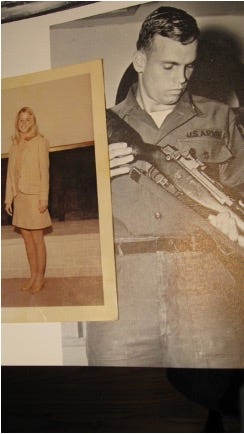
First Love
I was baking in the September heat, waiting for the Commander of the Honor Guard to troop the line and demand of me the one manual of arms I could not perform. At a spindly 5’5” and 120 pounds, I would have to do Inspection Arms if I wanted to make the Honor Guard, the elite marching unit in our high school ROTC. I felt it was my destiny to be in the Honor Guard.
At parade rest, propped up in the merciless sun like an abandoned scarecrow with no spine and bending my knees to prevent passing out but not so much as to look like I was bending my knees, I sweated from every pore. Across from our platoon formation, over at Crowell Field, the Pioneer football players were going through their line drills in blue practice pinnies, turned black from sweat. Pre-season football tryouts and Honor Guard tryouts—the male rites of passage in my town.
“GROUP, A-Tennn-HUT!”
I was taken by surprise at the command bleated by a member of the Honor Guard cadre, so I snapped to attention a split second behind the other candidates, drawing my weapon spasmodically back beside my right leg like a splint at the ready, heels touching, feet at a perfect 45° angle. Well, maybe only 40°.
The Honor Guard Commander had arrived.
Nick Bullard was a jut-jawed rock of a senior boy who should have been playing fullback and plowing over defensive tackles over at Crowell Field, but he played no sports. He probably had no sense of humor either. As commander of the Honor Guard, Bullard held the cadet rank of Lieutenant Colonel, and he was one of a handful of cadets in the running for Brigade Commander and promotion to Colonel.
Nick Bullard had achieved everything I aspired to.
Accompanied by a small cadre of returning Honor Guard minions, Bullard began one of the many Army rituals that cull the unworthy and reward the elite: inspecting the troops. Whenever he troops the line, an inspecting officer moves in a timely fashion from soldier to soldier, left to right down the rank, making sharp facing movements. When he stops and turns to face a particular soldier, that man, sans command, performs Inspection Arms and presents his rifle to the inspector. The movement requires the strength in your left arm to open a bolt whose tension spring is wound so tight it is usually opened by the recoiling force of a fired bullet. I did not have the strength of a bullet in either arm.
Unable to break discipline and turn my head to look, I could only hear the vicious hazing some of my sweating cohorts were receiving from the Honor Guard cadre, who flitted around the hapless candidates like harpies. I thought, what’s a male harpy called, a harpo? I chuckled aloud at my nervous internal monologue, raising the eyebrows of one of the cadre, thankfully undeterred from scaring the bejeesus out of the man next to me.
Bullard himself seemed to be saying little or nothing. I could hear him snatching a weapon from a candidate, checking first the shine on the brass strap hook, twirling the rifle once, looking into the breech, holding the piece to one side so he could peer down the barrel, twirling and stopping the ten-pound rifle as if it were a flimsy tent pole, flipping up the buttplate, twirling it back to Port position, and returning the lethal prop to the terror-stricken candidate, all in a matter of seconds.
When he got to the private next to me the sweat from my brow finally dribbled into my eyes, while a slippery, salty runnel simultaneously flowed from my wrist into the palm of my left hand.
All at once he was in front of me. I had known I was next, but his quick facing movements took me by surprise anyway. Frozen in sweat for a half-second, I blinked woodenly at Nick Bullard, my ROTC life on the line.
“Well?” he said, shocking me into action.
I botched it. I pulled the rifle up to Port Arms easily enough, but my sweaty left thumb slipped off the operating handle and I failed to open the bolt even halfway. After it clanged shut, I just stood there at Port Arms, breech closed, head sunk deep up my ass.
“What’s your name, mister?” asked the Honor Guard Commander.
“Smith, sir.”
“Is that the way you’re supposed to answer a question, Mister Smith?” Nick Bullard’s voice contained no outlandish volume or ferocity. Its very softness laced it with authority.
“Sir, my name is Cadet Candidate Smith!”
“Try again, Candidate.”
I tried to open the bolt from Port Arms but in that position I couldn’t budge the operating handle. I put the rifle back down at Order Arms so that I could give it upward momentum at the same time that I shoved downward on the operating handle, an instinctive Newtonian compensation for my innate weakness.
This time I opened and secured the bolt on an M1 rifle for the first time in my life.
Bullard snatched the weapon from me, leaving my hands empty and suspended in the space between us like a puppet stripped of his toy.
“You can lower your arms, mister.”
I did.
He went through his routine movements so quickly and precisely as to become their own manual of arms. When his hand stopped the rifle on the last spin, the force of the blow jarred loose the operating handle and the bolt crept forward enough to catch on the follower. It was one precarious misstep from slamming shut. Nick Bullard looked at me.
“Good thing I already inspected the breech, eh, Smith?” he said, glancing at my crooked nametag.
“Yessir!” I screamed.
“Good spirit, Smith.”
With this unexpected accolade, the Honor Guard Commander handed me back my weapon and moved on to the next trembling candidate.
I wasn’t out of the woods. Bullard had left me in a predicament. To finish Inspection Arms properly, I had to release a bolt halfway released already, and to do this I had to stick my thumb into the breech to depress the follower. Booby trap! I was in semi-mortal peril of having the bolt slam my thumb against the chamber if I couldn’t hold the poised tension spring at bay with just the knife edge of my right hand.
Nick Bullard was no longer inspecting me, but he was close enough to hear any sloppy movement I might make returning the rifle to Port and Order Arms.
My mind whirled. Which was more important: making sure Nick Bullard heard me release the bolt without screwing it up, or avoiding a blood blister or a broken thumb? I decided to risk neither and returned the weapon to Order Arms without releasing the bolt, giving an extra oomph to the move. When the butt of the M1 hit the ground beside my foot, the bolt slammed shut as I had hoped it would.
I stole a glance at the Honor Guard Commander, who, yes, was glancing back at me. He had a sly smile on his face. We both knew that the final act of Inspection Arms, pulling the trigger, had not been consummated, but my self-esteem was intact.
A few days after Honor Guard tryouts (I made it, don’t ask me how), I saw Nick Bullard sitting at a lunch table in the cafeteria. Hovering around him were a few Honor Guard lackeys, but I barely noticed them because of the glowing bundle of female energy sitting next to Nick, a luminous little fairy darting all over the room without ever leaving her chair: hanging on his shoulder to talk to someone across the table, leaning into his side to meet his gaze, holding his hand as she strained backwards to converse with a girl at the table behind her, and then folding herself back into him.
She was blonde like Nick, but where his hair was sandy, coarse, and cropped military close, hers was thin, limp, long, and as white as a crayon. She wore no makeup to mar her perfect skin with false color, and that day—the first day I ever saw Lin Holly—she had on the white letter sweater and skirt of a junior varsity cheerleader, so that the only blotch of color was the shimmering blue “L” in the center of a white-hot star.
Nick Bullard graduated in June of 1962 and became a legend only and no longer a threat to the manhood of underclass boys. The day he left high school was also the day I ascended to twelfth grade.
Becoming a senior automatically clothed me in a mystique there is no other earthly way to obtain. Boys who were social zeroes all their lives became seniors and POOF! they were cool. All of sudden, girls I’d ogled shyly from a distance—basically every girl in three grades—were paying attention to me, some even flirting. My expectations soared, but I had no experience being cool just because a few school mates now considered me cool.
When school started I met a cute new girl, Terry Young. She told me she was having a couple of friends over Saturday night and asked me to come. Word got around, and about ten other people showed up unexpectedly.
There’s an element of risk and kismet in a night nobody anticipates. We danced to Johnny Mathis forty-fives till two in the morning. Nothing’s more intoxicating than holding a beautiful girl in your arms while Johnny Mathis assures you in mellow tones that your chances are awfully good. I missed my curfew by two hours.
With an Army colonel for a father, I had never before this night had the guts to contravene his rules. I wasn’t sure it was guts I was showing tonight either. Fatuously, I thought my parents would have gone to bed by this late hour, sparing me another embarrassing scene. For insurance, I turned off the headlights and coasted the Buick to a stop, but it didn’t matter: my parents were sitting in the living room waiting up for me.
“What the hell do you think you’re doing, young man?” said my dad. After that, the conversation isn’t worth recording.
I got a month’s restriction. No dates, no driving the car, and no staying after school for clubs or socializing. Terry Young and I were history before we even had a chance to become an item.
I emerged from the month’s restriction with no girlfriend at a time when it seemed as if the entire school had coupled up during my dating hiatus. Terry Young was going steady, Billie Jean Battle, whom I had taken once to the drive-in, was going steady, even the other drive-in date whose name I had disremembered was going steady. I had never been confident asking girls for dates, and now, even if I could find the gumption, it seemed there were no girls available.
It took me weeks to recover fully. Weekend after weekend, I attended dances with a pack of bachelors, a tidy euphemism for those senior boys who had similar timidities. I hated my father for ruining my senior year and was mortified again, this time by not having a date for the Senior Prom.
Riding the bus home in early May, Archie McGill asked me who I was going to the Prom with. My answer was barely audible. “Nobody.”
Archie said, “Why don’t you ask Lin?” Lin Holly, of course, was sitting two benches away, listening to us.
So I did. She said yes. The moment of offer and acceptance is blurred in the rush of asking her as the bus came to her stop. The date and the girl grow in my memory like a luminous seed crystal.
Lin lived three minutes from my driveway, but on Prom night I left my house in our Desert Sand ’62 Buick Special a half hour early and circled her block at least ten times before parking at the curb of her father’s quarters. As I approached her front door, my steps became scarecrow-like, my mouth a receptable for discarded cotton. Opening the door, Lin was a halo in the hallway, her parents lurking like last year’s courtesans behind the light radiating from her glowing yellow dress.
“Hi, Vill,” she said, “these are my parents.”
Her father stepped forward gruffly, a colonel like my father. He grunted something unintelligible, shook my hand, and skulked back to his chair to pretend to read the newspaper. I realized that I must be the twentieth pubescent male to date his daughter, so the ritual of proffering her to another undeserving fellow had become stale to him, his duty to greet the new pest obligatory, my face and person nondescript and forgettable.
Her mother gushed about how precious we both looked in our tuxedo and formal, and she took our picture with her Polaroid. At my mother’s suggestion, I had bought a white corsage, which would match any color dress—because I had been too scared to call Lin about the color of her prom gown. Lin’s mother pinned the corsage on the bodice of her strapless yellow chiffon dress. I was petrified to pin it myself, not only because I might prick her unblemished skin but because I might actually have to touch her flesh within millimeters of second base.
I almost touched Lin when I held the Buick’s passenger door open and reached out to guide her into the seat, but my extended hand never made contact with her back, more or less waving her into the car. In an instant, Lin took charge and dissolved years of anxiety about touching girls: as soon as I sat behind the steering wheel, she slid over next to me and curled both hands around my arm. I tingled.
At the dance, Lin held my hand as if we’d been girlfriend and boyfriend for two whole weeks, and we beamed whenever we said hi to friends, proud to be seen in each other’s company. At a break in the music, we sat with some friends at a table, and Lin grabbed my hand and leaned into me, dazzling and talking with everybody at once. It hadn’t escaped my notice that I had replaced Nick Bullard in the lunchroom tableau of the first time I’d seen her.
When I took her home, we sat in the Buick for a minute outside her quarters and talked, cuddling close. “Lin,” I said, “I want this to sound sincere. This was the best date I ever had.” It came out sounding phony, a line designed to get something, a kiss or another date. But it was also true. Never in my life had I felt so good about being Vill Smith.
For the rest of the school year, Lin and I were inseparable. We sat together at every school function, parked every weekend and made out, experimented with touching each other in places I’d fantasized about, but we never “went all the way.” Lin always controlled the petting, but I didn’t mind. Being with her made me forget about leaving for military school until the time was upon us. She cried when I left.
At West Point, Inspection Arms with an M1 rifle was no problem because we marched with M14s, which snap open with modest pressure and stay open and don’t produce “M1 thumbs.” My sinewy body was still not strong but getting stronger. I never got hazed about my marching while plebes around me with less experience got yelled at for having two left feet or bouncing too much or wrapping the rifle around their necks.
I wasn’t noticed, and that, I learned, was the key to survival as a plebe. Instead of trying to be cock of the walk, I sought the safety of anonymity. One was left alone if one were mediocre, so I became the best mediocre plebe in my company.
Except when it came to girlfriends.
My classmates displayed pictures of their girlfriends on their desks, and it wasn’t much of a step to begin comparing them and arguing over whose girlfriend was better looking. I wrote Lin and she sent me her senior photo, which satisfied my classmates that Vill Smith had a pretty girlfriend.
Because being a lowly plebe—and one striving for mediocrity to boot—cost me whatever coolness I’d gleaned from being a high school senior, Lin’s picture became my lone source of coolness. Over the six months between a tearful goodbye kiss in June and our impending reunion at Christmas break, she had become a status symbol whose photographic image served my depleted ego in my new circle of friends more than the real person had in the old one.
Without the flesh and blood Lin, however, my confidence in our relationship waned. A couple of my classmates had already lost their girlfriends. One of my roommates had received a “Dear John” letter in which his girlfriend admitted meeting a “special” boy at her new school.
In the face of my roommate’s anguish, my own psyche suffered a new paranoia. Had Lin replaced me as she’d replaced Nick Bullard?
When I pulled up to her house in my rented Ford Falcon the first day of that snowy Christmas leave, I had come prepared to break up with Lin before she broke up with me. Before I could reach her front door, however, she burst out of the house, ran down the shoveled walkway and jumped into my arms, her legs scissoring my dress gray uniform at the waist. As she kissed me with six months of pent-up passion, I became confused. I couldn’t requite her affection with a breakup. I didn’t see myself as that cruel.
Over the two weeks of Christmas vacation, I escorted Lin to all the parties she’d lined up for us. But I was uncomfortable with the whole scene. I seemed to be marching around robotically in some kind of surreality, no longer the studly high school senior but, as a damaged plebe, not the cool college man either. I started to grow quiet, and I’m sure Lin felt my emotional distance. The day before I was to return to school we almost bridged that gap.
We were alone in my billet at the Bachelor Officers Quarters, sitting together on the bed and petting heavily, and a look came over her face I’d never seen before, a submissive look of love and longing and maybe a little desperation. It melted me. In Lin’s vulnerable moment I understood she was offering me the gift a girl can give only one time in her life, but all I could think of was my intention to break up with her. Instead of feeling powerful or fortunate or even thankful, I was reminded of how helpless I’d felt the moment I performed Inspection Arms: Nick Bullard had snatched my rifle, and my arms were suspended puppet-like in front of me, hands bereft of my power, my soul at the mercy of an inertia out of my ken.
The next day, while she was driving me to the airport, I followed through with my original intentions. I told Lin we should see other people. The sincerity of her tears crippled me inside, but outside I remained as unwrinkled as my dress gray uniform.
We had been split up for a year when Lin sent me a photograph of herself standing alone in front of a brick fireplace, a mature young college freshman with stylish shoulder-length hair, a smart plaid jacket and matching miniskirt, low heels that complemented her shapely legs, and a forced half-smile.
She’d written on the back of the photograph, “Vill, Memories . . . Love, Lin.” The ellipsis was painful.
Good one. Keep it up.